

Back in December, media historian and legal expert Tim Wu wrote in the New York Times that both the Netflix and Paramount offers “would be bad for the country, and both should be challenged by antitrust authorities. The message to Warner Bros. Discovery should be: If you must sell, maybe try finding a buyer who is not a direct competitor.” Federal Trade Commission guidelines, usin their own language, “raise a presumption of illegality.”
There has been plenty of nitpicking about who is a direct competitor. Netflix argues it’s everyone vs. YouTube, which has been echoed by Paramount more recently. However, we know that the Disney merger with 20th Century Fox quickly led to mass layoffs and less output, a massive loss for industry employment and entertainment consumers. Despite David Ellison’s promises that this merger will only grow both companies, we have ample reason to believe the opposite.
There’s also the question of CNN, of course, which his raised a great deal of partisan quibbling. Of course, the alleged side-deal with President Trump to rework CNN in his vision is horrid and should be investigated. Regardless of whatever slant the network may push with an Ellison aquisition, the bigger issue is the number of major media outlets that would be owned by a signle entity. The CNN issue, while important, is a distraction from the essential compontents here - antitrust law.
For those who need to revisit the primary sources, or read them for the first time, here they are.
Here is a key piece of history that applies today, not only to the entertianment space but the tech world as well. We’re inching ever closer to monopolistic practices in Hollywood as this merger mania continues. After all, we can wonder if YouTube will swoop in and pick up the newly merger Warner/Paramount or one of these other conglomerates in a few years?
“Toward the end of the 19th century, trusts come to dominate a number of major industries, destroying competition. For example, on January 2, 1882, the Standard Oil Trust was formed. Attorney Samuel Dodd of Standard Oil first had the idea of a trust. A board of trustees was set up, and all the Standard properties were placed in its hands. Every stockholder received 20 trust certificates for each share of Standard Oil stock. All the profits of the component companies were sent to the nine trustees, who determined the dividends. The nine trustees elected the directors and officers of all the component companies. This allowed Standard Oil to function as a monopoly since the nine trustees ran all the component companies.”
The above is why the Clayton Antitrust Act was enacted a generation later because it became clear to see the workings of an aspiring monopoly in the making. Stopping them is much easier than dismantling them after the fact. Right now, the question is competition and any merger kills competition by empowering a small group of board members to control a sizeable portion of the industry.
“The Act supplemented and strengthened the Sherman Act of 1890, an existing antitrust bill that had failed to effectively regulate the massive corporations. The newly created Federal Trade Commission enforced the Clayton Antitrust Act and prevented unfair methods of competition. Aside from banning the practices of price discrimination and anti-competitive mergers, the new law also declared strikes, boycotts, and labor unions legal under federal law.”
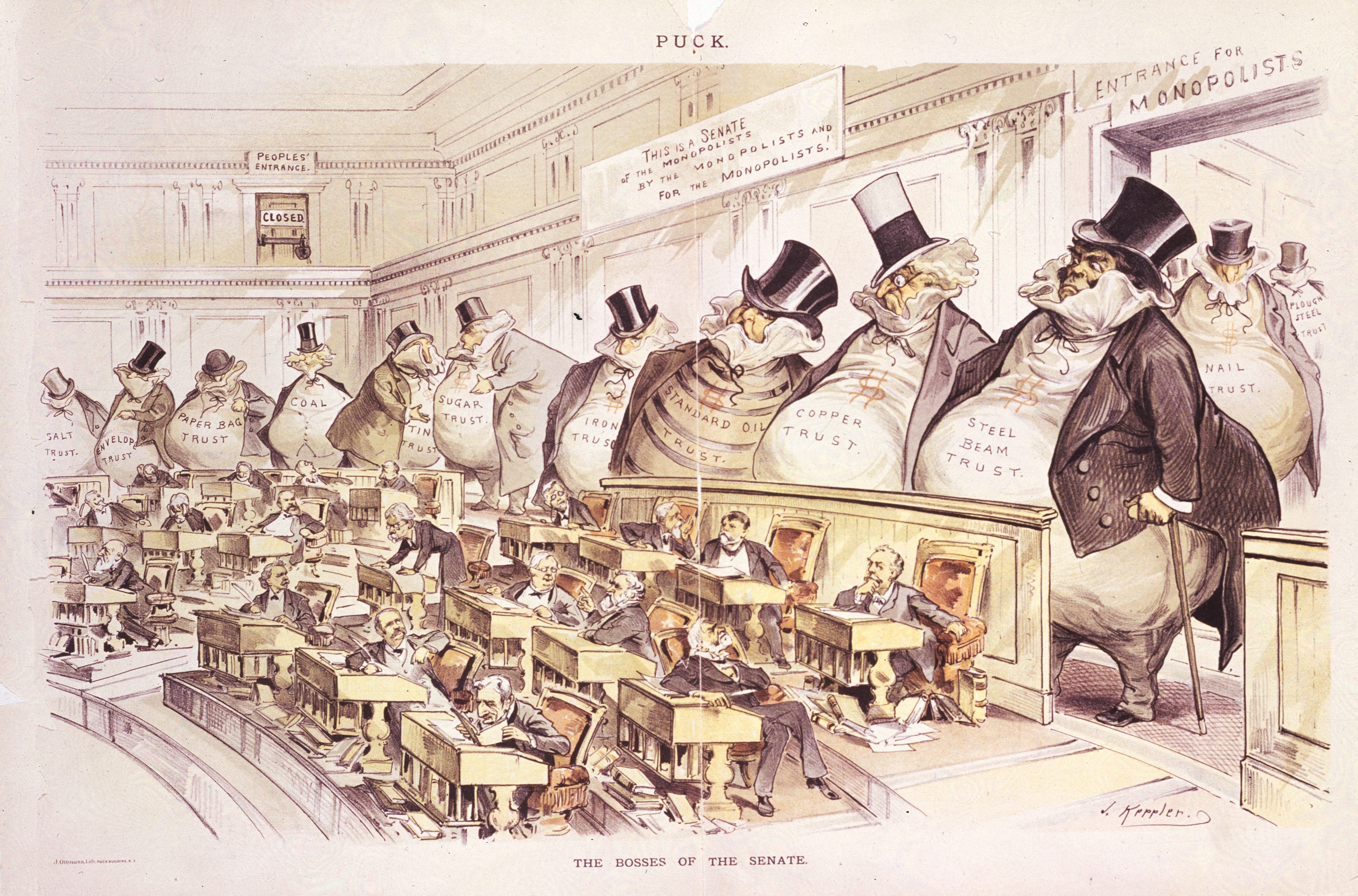
There are teams of high-priced lawyers working tirelessly to twist these words into knots in order to prove that merging two major studios would be good for everyone. I’ve watched soulles state-level attorneys do the same thing in Wisconsin as they argued that university tenure could be severed for reasons other than those specified in state law. The lesson here is that the law often doesn’t matter, which is terrifying. That’s why the 1889 cartoon picture above is still on-point. The only thing that matters is who owns the those who interpret that law.
In addition, the last few years of major media and publishing mergers have made me curious to learn more about Teddy Roosevelt and the trust-busting era…(feel free to share reading recommendations!)
Also on my reading list is Amy Klobuchar’s book on the history of antitrust wars, which feels increasingly important reading today.
Update Monday July 20
A federal judge has issued an injunction citing merits of the Clayton Act. Here’s the judge’s quote as seen in The Hollywood Reporter.
“Because the Plaintiff States raise serious questions on the merits of their Clayton Act claim and because the balance of equities and public interest tip sharply in favor of the Plaintiff States, the Court ultimately finds the public interest favors their requested TRO to stay the merger in the interim,” Martínez-Olguín wrote in the order.